Special Care for Thermal Paper
Instructions for direct thermal label stock proper care and storage

Instructions for direct thermal label stock proper care and storage
Thermal paper is relatively fragile. Because of this, certain precautions must be followed to prevent any premature deterioration during storage or while handling until the end of its use.
Ricoh Thermal papers can be unused without any deterioration for a long time after production if they are stored in the dark at temperatures that do not exceed 95° F and a relative humidity not exceeding 85%.
In addition to the above care, avoid long term exposure to direct sunlight and strong fluorescent light sources. These light sources can generate some background coloration if left unchecked. Do not place Ricoh Thermal paper near heat sources.
Avoid any contact with materials composed of, or containing, solvents or plasticizer. Avoid/minimize any scratching or rubbing as this may cause unwanted thermal revelation. Avoid any contact with water.
At Ricoh, our thermal papers consists of a base paper coated with four different chemical layers on the front that create their unique thermal and protection properties. The following is an overview of these layers. Please note that this overview does not include information on the adhesive layer or the silicon release liner.
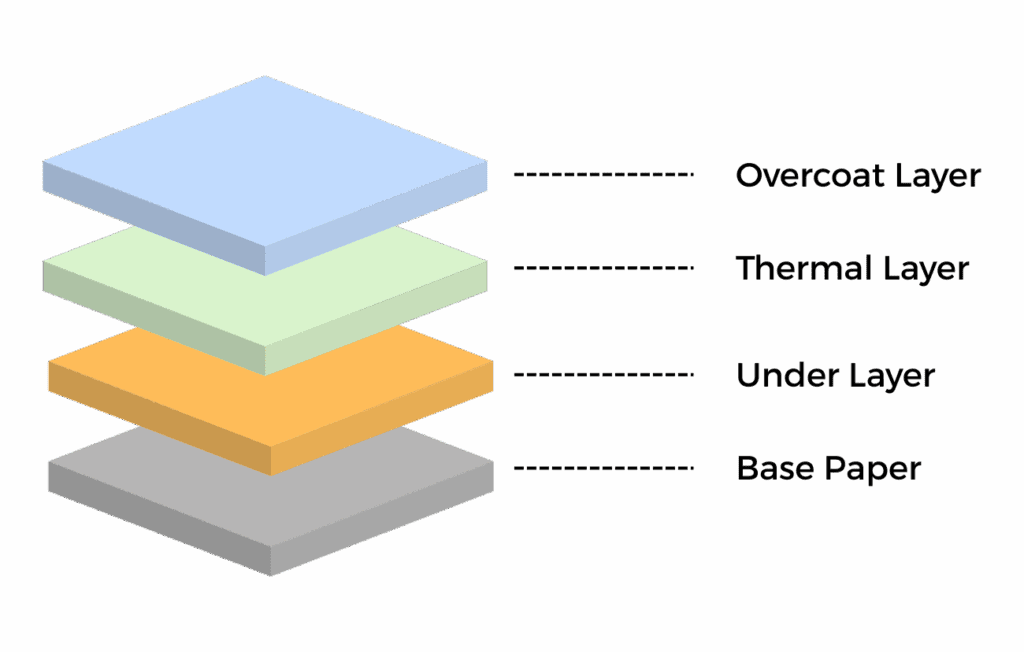
This layer is specifically designed for aesthetic and technical properties alike. Aesthetic properties include color, whiteness, brightness, and opacity. Technical properties include thickness, basis weight, tear strength, tensile strength, stiffness and coating compatibility.
The under layer has two main functions:
1. It smooths out the porous surfaces of the base paper to increase contact area with the thermal print head
2. It utilizes Ricoh’s Super Micro Ball technology to retain more heat to drive the dye/developer reaction forward with more efficiency.
This layer contains a blend of the leuco dye* and the developer** which allows for color forming once heat is applied.
*Leuco dyes are chemicals which can switch between colorless and colored forms. A popular example is hypercolor clothing which uses a leuco dye to change color with heat.
**Developers are organic acids that promote the color forming reaction when melted together with a leuco dye.
The 1st overcoat or barrier layer is a transparent polymer layer designed to protect the thermal coat from premature darkening due to abrasions and environmental weathering. Without this layer, our labels would be much more prone to scratches or marks that may interfere with the scanning of barcodes.
The 2nd Overcoat or Matching Layer is a polymer layer that contains a filler designed to prolong the lifespan of thermal printers. Without this layer, end users’ print heads would wear out much more quickly.


Stay connected with the latest from Ricoh Electronics — news, updates, and more.